
What is AOD-9604?
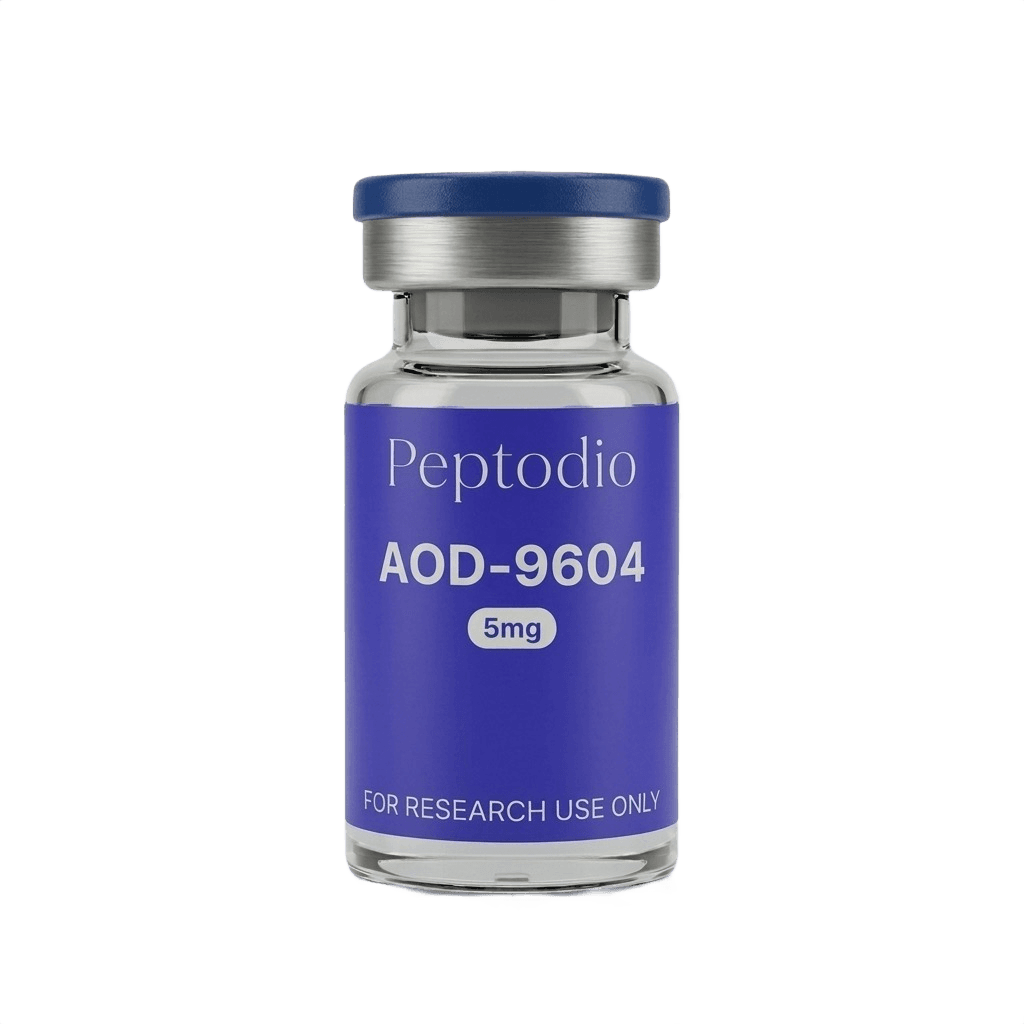
AOD-9604 (Anti-Obesity Drug-9604) is a modified fragment of human growth hormone (hGH), consisting of amino acids 176-191 from the C-terminal region. This synthetic peptide was developed to isolate the fat-reducing effects of growth hormone while eliminating the growth-promoting and diabetogenic properties.
Developed by Metabolic Pharmaceuticals in Australia, AOD-9604 has been extensively studied as a potential anti-obesity agent, with research focusing on its lipolytic (fat-burning) effects without the side effects associated with full growth hormone administration.
The Science Behind AOD-9604
Growth Hormone Fragments
Human growth hormone is a 191-amino acid protein with multiple functional domains:
Full hGH Effects:
C-Terminal Fragment (176-191):
AOD-9604 is this C-terminal fragment with an additional tyrosine residue at the N-terminus for stability.
Mechanism of Action
Lipolytic Pathway:
- AOD-9604 mimics hGH's lipolytic action
- Stimulates fat cell receptors
- Activates hormone-sensitive lipase
- Triglycerides broken down to fatty acids and glycerol
- Released fatty acids available for oxidation
- Energy production from fat stores
- Reduces new fat synthesis
- Decreases fatty acid incorporation into adipocytes
- Dual action: burning + preventing accumulation
Key Distinction:
Unlike full hGH, AOD-9604 does not promote:
Peptide Profile
| Property | Details |
|---|---|
| Full Name | AOD-9604 / Tyr-hGH Fragment 176-191 |
| Sequence | Tyr-Leu-Arg-Ile-Val-Gln-Cys-Arg-Ser-Val-Glu-Gly-Ser-Cys-Gly-Phe |
| Amino Acids | 16 |
| Molecular Weight | ~1,817 g/mol |
| Origin | Modified hGH fragment |
| Purity | 99%+ (HPLC verified) |
| Form | Lyophilized powder |
Clinical Research History
Early Research (Metabolic Pharmaceuticals)
Preclinical Studies (1990s-2000s):
Phase 2 Clinical Trials:
Clinical Trial Results
Phase 2b Trial (2004):
| Group | Weight Change | Fat Mass | Lean Mass |
|---|---|---|---|
| Placebo | +0.2 kg | — | — |
| AOD-9604 | -2.8 kg | Reduced | Maintained |
Observations:
Regulatory Journey
Timeline:
Current Status
Research Applications
Metabolic Studies
Adipocyte Research:
Obesity Models:
Comparative Research
AOD-9604 vs Other Weight Loss Peptides:
| Peptide | Mechanism | Primary Effect |
|---|---|---|
| AOD-9604 | hGH fragment, lipolysis | Fat metabolism |
| Semaglutide | GLP-1 agonist | Appetite suppression |
| Retatrutide | Triple agonist | Multiple pathways |
| CJC-1295 | GHRH analog | GH release |
See our semaglutide guide for GLP-1 comparison.
Combination Research
Researchers may study AOD-9604 with:
Dosage Protocols in Research
Reconstitution
AOD-9604 requires reconstitution from lyophilized form:
Standard Protocol:
| Vial Size | Bacteriostatic Water | Concentration |
|---|---|---|
| 2mg | 1ml | 2mg/ml (2000mcg/ml) |
| 5mg | 2ml | 2.5mg/ml (2500mcg/ml) |
Procedure:
Enjoying this article?
Subscribe to get notified when we publish new experiment reports and research findings.
No spam, unsubscribe anytime.
Use our peptide calculator for accurate dosing.
Research Dosing Ranges
Clinical trials have examined various protocols:
Trial Dosing:
Specific protocols should follow institutional guidelines and research design.
Storage Requirements
Lyophilized Form
Optimal Conditions:
Reconstituted Solution
Requirements:
See our storage guide for detailed protocols.
AOD-9604 vs Semaglutide: Comparison
Mechanism Comparison
| Aspect | AOD-9604 | Semaglutide |
|---|---|---|
| Target | Fat cells directly | GLP-1 receptors |
| Primary Action | Lipolysis | Appetite suppression |
| Weight Loss | ~3-4% (trials) | ~15% (trials) |
| Administration | Daily (typical) | Weekly |
| Side Effects | Minimal | GI effects common |
| Approval Status | Research only | FDA approved |
Research Considerations
AOD-9604 Advantages:
Semaglutide Advantages:
Safety Profile
Clinical Trial Observations
Phase 2/3 Data:
Common Observations:
Research Considerations
Important Notes:
Comparison to Full hGH
| Effect | Full hGH | AOD-9604 |
|---|---|---|
| Weight/Fat Loss | Yes | Yes |
| IGF-1 Increase | Yes | No |
| Insulin Resistance | Risk | No |
| Fluid Retention | Yes | No |
| Growth Effects | Yes | No |
This selective profile is AOD-9604's key research advantage.
Quality Considerations
Research-Grade Requirements
Essential Quality Markers:
Storage Equipment
Frequently Asked Questions
What is the difference between AOD-9604 and HGH?
AOD-9604 is a small fragment (16 amino acids) from the C-terminal end of growth hormone (191 amino acids). It retains the fat-metabolizing effects of GH while lacking the growth-promoting, IGF-1 raising, and potentially diabetogenic effects. This selective action is AOD-9604's primary research advantage.
Has AOD-9604 been tested in humans?
Yes. Multiple phase 2 clinical trials were conducted in Australia, demonstrating modest weight loss and good tolerability. Phase 3 trials did not meet primary efficacy endpoints, leading to discontinuation of pharmaceutical development. However, it received GRAS status for food applications and remains available for research.
How does AOD-9604 compare to semaglutide for weight loss?
Semaglutide (GLP-1 agonist) produces greater weight loss (~15%) through appetite suppression, while AOD-9604 showed modest effects (~3-4%) through direct lipolysis. They work through completely different mechanisms. See our semaglutide guide for details.
What is the proper storage for AOD-9604?
Store lyophilized AOD-9604 at -20°C for maximum stability. Once reconstituted with bacteriostatic water, refrigerate at 2-8°C and use within 4-6 weeks. Protect from light and never freeze reconstituted solution.
Does AOD-9604 affect blood sugar or insulin?
Clinical trials found no significant effect on glucose metabolism or insulin sensitivity, unlike full growth hormone which can cause insulin resistance. This is a key safety advantage and was a primary reason for developing this specific fragment.
Can AOD-9604 be combined with other peptides?
Combination research is an active area. AOD-9604's mechanism (direct lipolysis) differs from GLP-1 agonists (appetite suppression), potentially allowing complementary effects. All combination protocols should be carefully designed with appropriate controls.
Related Resources
Conclusion
AOD-9604 offers researchers a unique tool for studying fat metabolism independent of growth hormone's other effects. While clinical development as a pharmaceutical was discontinued, the peptide's selective lipolytic activity and favorable safety profile maintain scientific interest.
For metabolic researchers, AOD-9604 provides insights into the structure-function relationship of growth hormone fragments and the potential for targeted therapeutic approaches.
Use our calculator for research preparation.
Related Weight Loss Peptides
This article is for informational purposes only. AOD-9604 is sold for research purposes and is not intended for human consumption. All research should be conducted in accordance with applicable regulations.