

The Question, and Why "Don't Mix" Isn't an Answer
Three questions arrive together constantly, and they're always the same three. Can KLOW go in the same syringe as CJC-1295 no-DAC and Ipamorelin? Can both vials be reconstituted from the same bacteriostatic water? And how far does GHK-Cu have to be diluted before it stops stinging?
The motivation behind all three is usually identical: the GHK-Cu stings, so it needs diluting, and nobody wants an extra puncture to achieve that.
The standard response is "don't mix, don't even pin the same spot," offered with no explanation, usually followed by some version of "why would you want to?" The goal - fewer punctures - is completely reasonable, and the answer given is a flat no with no mechanism attached.
So here's the full answer. It's more interesting than either camp suggests, because the usual reason for wanting to mix rests on a false premise, and once you see that, the whole problem dissolves.
First: Your Dilution Problem and Your Pin-Count Problem Are Unrelated
This is the single most useful thing in this article, so it goes first.
You want to mix CJC-1295/Ipamorelin into your KLOW to dilute the GHK-Cu. But dilution comes from *volume*, not from what's dissolved in that volume. Adding 1mL of CJC/Ipa solution dilutes your GHK-Cu exactly as much as adding 1mL of plain bacteriostatic water - no more, no less. The GH peptides contribute nothing to the dilution except their own presence.
So mixing buys you zero additional dilution over what bacteriostatic water alone would give you. If sting reduction is the goal, the CJC/Ipa is pure passenger.
That leaves one genuine benefit to mixing: one puncture instead of two. And as it turns out, you can have that without co-mixing anything (see the sequential draw section below).
Two problems, two separate solutions. Stop trying to solve both with one vial.
What's Actually in KLOW
KLOW is a fixed four-peptide lyophilized blend, and the ratio matters enormously here:
| Component | Amount | Share of total |
|---|---|---|
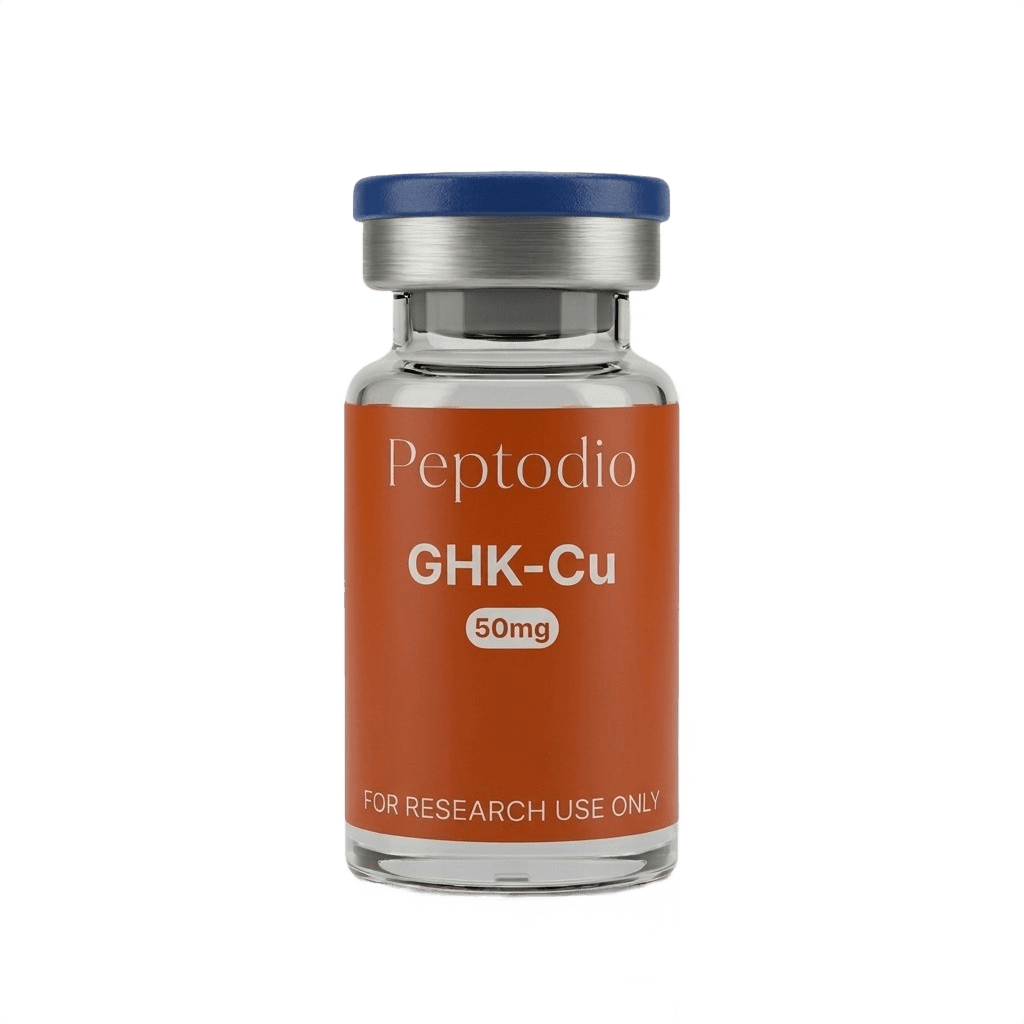
| GHK-Cu | 50 mg | 62.5% |
| BPC-157 | 10 mg | 12.5% |
| TB-500 | 10 mg | 12.5% |
| KPV | 10 mg | 12.5% |
| Total | 80 mg |
GHK-Cu is nearly two-thirds of the vial by mass. That single fact drives everything below - both the copper chemistry and the reason you cannot dilute your way out of the sting.
Part 1: The Chemistry Problem Is Copper, and It's Time-Dependent
Why copper is the one real objection
Most "don't mix peptides" advice is vague. With GHK-Cu there's a specific, named mechanism: metal-catalyzed oxidation.
GHK-Cu is glycyl-L-histidyl-L-lysine complexed with a Cu²⁺ ion. Copper is not an inert passenger - transition metal ions are among the best-characterized catalysts of oxidative degradation in protein and peptide pharmaceuticals. Cu²⁺ drives site-specific oxidation, with histidine, methionine, cysteine, and tryptophan residues as the primary targets. This is standard formulation science, which is why real pharmaceutical products include chelators like EDTA specifically to sequester trace metal contamination measured in parts per billion.
You're not dealing with parts per billion. You're putting 50mg of a deliberately copper-loaded peptide into the same solution.
What's actually vulnerable in your GH stack
Here's where it gets specific:
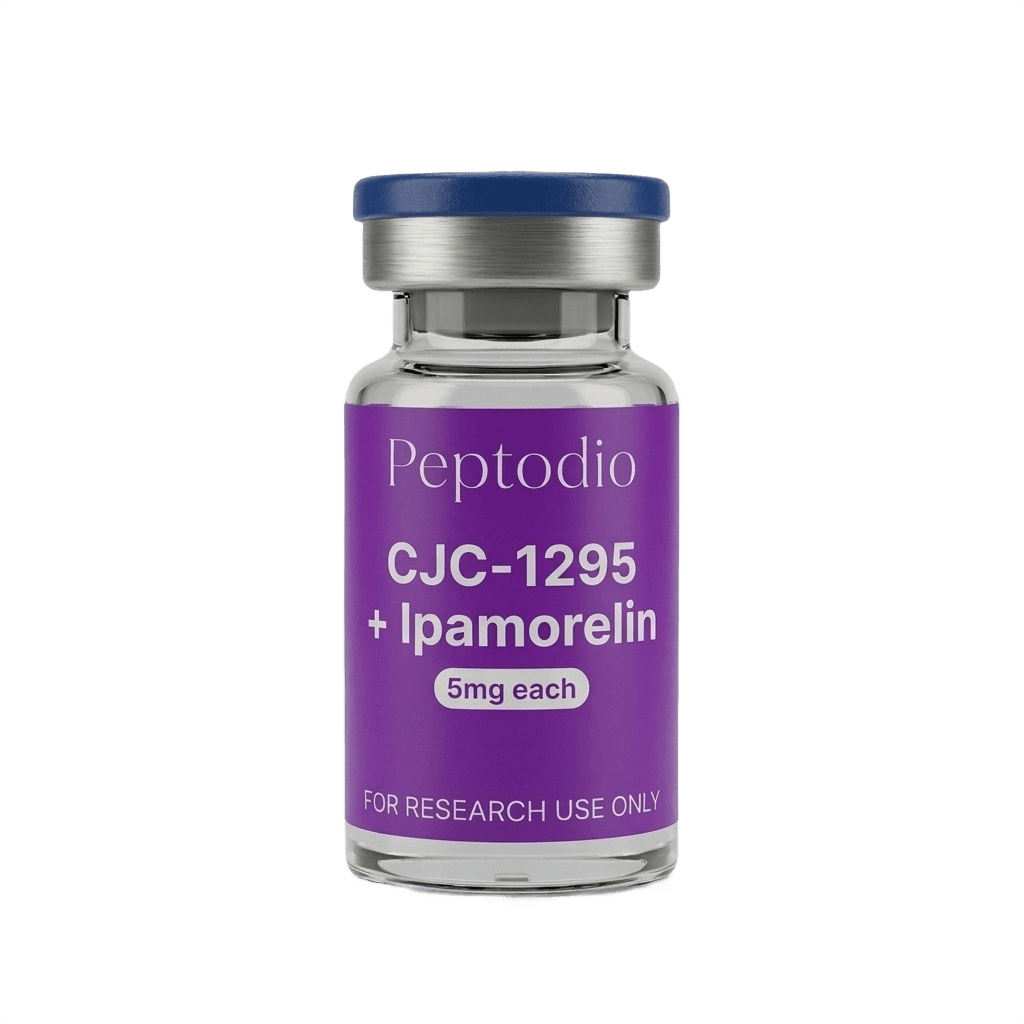
Ipamorelin is Aib-His-D-2-Nal-D-Phe-Lys-NH₂. Five residues, and position two is histidine - the single most copper-reactive residue there is, and itself a copper-binding site. It's a short peptide, so there's no folding to protect it.
CJC-1295 without DAC (modified GRF 1-29) is more interesting. Its four substitutions off native GHRH are each there for a reason: D-Ala² resists DPP-4 cleavage, Gln⁸ prevents asparagine deamidation, Ala¹⁵ boosts potency, and Leu²⁷ replaces methionine specifically to remove an oxidation site. The molecule was engineered against exactly this failure mode. That's reassuring - but it still carries histidine residues, and "designed to resist oxidation" is not "immune to a copper catalyst."
The part both forum camps get wrong
Oxidation is a rate, not a switch. Rates need time.
"Don't mix" is right about the vial and overstated about the syringe. "It's fine, peptides are tougher than people think" is right about the syringe and wrong about the vial.
The quiet implication for KLOW itself
Notice that KLOW is *already* a copper peptide sitting alongside three other peptides. That's fine as a dry lyophilized powder - no solvent, no mobility, no reaction. But the moment you reconstitute it, that clock starts for BPC-157, TB-500, and KPV too.
Which means reconstituted KLOW has a shorter practical shelf life than reconstituted single peptides, and you should be mixing volumes you'll actually finish rather than loading a vial for two months. That's an argument for keeping your other compounds *out* of it, not for adding more.
Part 2: "Same BAC Water?" - Two Different Questions
This gets conflated constantly, and the two readings have opposite answers.
Same bottle of bacteriostatic water for both vials? Completely fine. That is precisely what a multi-dose preserved diluent is for. The 0.9% benzyl alcohol is a bacteriostatic preservative that lets you access the bottle repeatedly over weeks. Swab the stopper each time, use a fresh needle each time, never push anything back in, and one 30mL bottle serves your whole fridge.
Same vial or same syringe for both peptides? Entirely different question - that's the compatibility question answered above.
While we're here: use bacteriostatic water, not sterile water, and not just for the preservative. Benzyl alcohol has genuine local anesthetic activity - it's been studied as a substitute for lidocaine for exactly this reason. Sterile water has no preservative and no anesthetic effect. For a compound you're already finding painful, this is free comfort you shouldn't skip.
Part 3: The Concentration Math - What Actually Stops the Sting
Why GHK-Cu stings
Several contributors, roughly in order of impact:
There is no published threshold - but here's the practical range
Nobody has run a dose-ranging trial on subcutaneous GHK-Cu injection pain, so any number you see is pooled anecdote. With that stated honestly, the pattern reported is consistent:
| GHK-Cu concentration | Typically reported |
|---|---|
| 10 mg/mL and above | Stings sharply, often lingers |
| 5 mg/mL | Noticeable but tolerable for most |
| 2 mg/mL | Mild, usually described as a non-issue |
| 1 mg/mL and below | Generally imperceptible |
Target 2 mg/mL or lower. That's the practical answer to "what do I need to go below."
Why you cannot get there by diluting a KLOW vial
Now the ratio bites. GHK-Cu concentration in reconstituted KLOW is fixed at 50mg divided by your water volume:
| BAC water added | GHK-Cu | BPC/TB/KPV each |
|---|---|---|
| 4 mL | 12.5 mg/mL | 2.5 mg/mL |
| 5 mL | 10 mg/mL | 2 mg/mL |
| 8 mL | 6.25 mg/mL | 1.25 mg/mL |
| 10 mL | 5 mg/mL | 1 mg/mL |
Enjoying this article?
Subscribe to get notified when we publish new experiment reports and research findings.
No spam, unsubscribe anytime.
To reach 2 mg/mL of GHK-Cu you would need 25 mL of water in a vial that holds 10. It is not possible. The blend ratio locks GHK-Cu at five times whatever the other three sit at, and 5 mg/mL is roughly the floor you can reach in a standard vial.
This is the structural answer to the dilution question: no amount of mixing or diluting inside that vial gets GHK-Cu to a comfortable concentration. Not with bacteriostatic water, and certainly not with CJC/Ipa.
The fix: dilute in the syringe, not in the vial
Here's the technique that actually solves it, and it's the piece missing from most discussions.
You don't have to inject your peptide at the vial's concentration. Draw your dose, then draw additional bacteriostatic water into the same syringe before injecting. Vial concentration and injection concentration become independent variables.
Worked example with KLOW reconstituted in 10mL (GHK-Cu 5 mg/mL, others 1 mg/mL):
Same dose. Same single puncture. Comfortable concentration. No CJC/Ipa needed, no vial co-mixing, and your vial capacity isn't wasted.
The only constraint is total volume: most people tolerate up to about 1 mL subcutaneously without the volume itself becoming the problem. That gives you a lot of room.
Everything else that reduces the sting
Part 4: Getting Your One Puncture Without Co-Mixing
Three ways, in descending order of how much I'd recommend them.
Option 1: Skip the injection for GHK-Cu entirely
Of every peptide in your stack, GHK-Cu is the one with a genuine, decades-old topical evidence base. It's the active in a whole category of copper peptide skincare, and the skin-regeneration and collagen literature on it is largely topical work.
If your GHK-Cu is for skin, hair, or superficial tissue, topical application is not a compromise - it's the better-evidenced route. That takes your GHK-Cu pin count to zero, removes the sting question completely, and leaves you injecting only the GH secretagogue you were always going to inject.
This doesn't extend to the rest of KLOW - BPC-157 and TB-500 aren't meaningfully transdermal - which is itself an argument for buying components separately rather than locking yourself into a blend.
Option 2: Sequential draw, single puncture
If you want both compounds in one injection, you can do it without ever co-storing them:
Contact time: under a minute. Copper oxidation over that window is irrelevant. You get your one puncture, both vials stay chemically independent, and you keep the ability to change either dose without rebuilding anything.
What you still carry: both irritants land in one tissue depot. This is the real content behind the "don't even pin the same spot" advice - GHK-Cu already causes local reactions, and co-locating a second compound compounds that, plus you lose the ability to attribute a reaction to either one. If your sites are currently fine, this is a reasonable trade. If you're getting welts, separate the sites.
Option 3: Co-mixed storage vial
The option most people have in mind when they ask. I'd avoid it, and now you know specifically why:
The upside over Option 2 is that you save 30 seconds of preparation. That's it. The sequential draw gets you the same single puncture with none of the above.
The Straight Answers
Will mixing KLOW with CJC-1295/Ipamorelin cause problems?
In a syringe, injected immediately - no. In a shared storage vial over weeks - plausibly yes, via copper-catalyzed oxidation, and the damage is invisible. You'd also permanently lock your dose ratio and your injection timing.
Same bacteriostatic water?
Same *bottle*, yes, absolutely - that's what the preservative is for. Same *vial*, that's the question above.
What GHK-Cu concentration stops the sting?
Aim for 2 mg/mL or below; 5 mg/mL is tolerable for most people. These are pooled anecdote, not clinical data.
How do I get there, given KLOW's ratio?
Not by diluting the vial - 2 mg/mL would need 25mL of water. Dilute in the syringe at injection time instead: draw your dose, add bacteriostatic water, inject. Unlimited dilution, no wasted vial capacity.
Does mixing in CJC/Ipa help with the dilution?
No. Not even slightly more than plain water would. Volume dilutes; the solutes are irrelevant. This was the premise worth re-examining.
Can I still get one puncture?
Yes - sequential draw into one syringe, injected immediately. Or go topical with the GHK-Cu and drop that pin entirely.
One Honest Closing Note
"Why would you want to?" is an unhelpful response, because wanting fewer needles is not irrational - it's the most predictable preference anyone injecting things could have. The problem with the plan is never the motivation. It's that the mechanism chosen (co-mixing) doesn't deliver the benefit sought (dilution), while quietly importing costs that are hard to detect.
Separate the goals and both get solved cleanly: syringe-dilute for comfort, sequential-draw for puncture count, and consider going topical for the copper peptide entirely.
If you're running blends and finding the fixed ratios restrictive, that's the blend telling you something. Buying components separately costs a little more up front and gives you back every variable the blend took away.
Components, Bought Separately

Running a protocol where the blend ratio is fighting you? Describe the stack through the [contact page](/contact) and we'll work through the concentration math.
Disclaimer: This article is for informational purposes only and is not medical advice. Peptides are sold for research purposes and are not intended for human consumption.